

Why Is This Night Like So Many Other Nights?
On Passover tradition, timeless connection, and Lois Baron

There are two occasions that make me feel particularly connected to my Jewish heritage. The first is Passover, which started last night. Our annual Seder is the one remotely serious religious event we put on each year. Preparing for it always makes me wax poetic: about the dissonance between the satisfied song of “Dayenu” and our uncompromising mission to repair the world, about the incompatibility of the sweetness of our culture with the atrocities being committed in our name, about the importance of reclaiming our identify from the gentiles who tokenize us to crack down on ideological dissent, and about the very nature of nostalgia.
Ironically, I grew up not liking Passover. The stodgy formality seemed alien in our otherwise mostly secular family. I saw the Four Children as the Haggadah’s horoscope and feared being cast as simple or wicked rather than wise. And it never sat right with me that a holiday commemorating freedom had so many restrictions and rules. Somewhere along the way it became the primary demonstration of my connection to the Jewish faith. I’ve never fully been able to put my finger on why.

The other time I feel similarly inspired is while traveling abroad — as when we went to Barcelona earlier this year. A Jewish presence in the city is attested as far back as the early Roman colonization. To dramatically oversimplify many centuries of history, our people had it pretty good for a while, at least by the low standards of medieval Christendom. Of course the late Middle Ages were not a good time to be non-Catholic in Iberia. By 1400 the Catalonian Jewish community was effectively obliterated: expelled, forcibly converted, or killed. Recent scholarship has sought to rediscover and celebrate this slice of Jewish history, now preserved and recounted in museums around Barcelona. You can even visit the site of the central hub for Jewish life in Roman Barcino nearly two millennia ago, Sinagoga Major.
A significant portion of the Judaica artifacts we saw were related to Passover: Seder plates, Kiddush cups, Haggadot. I found myself profoundly moved by these displays. Of course Jews celebrated Pesach back then. But to see the actual ritual implements felt so personal and intimate. I could picture these families from so long ago filling their plates with the same food, reciting the same prayers as they filled their cups. I wondered if the kids around the table were as transfixed by the color and detail of their Haggadah’s illustrations as I was by the minimalist wine-red brushstrokes in the one my family used, and if they too had crossed their fingers in hopes of reading for the wise son.

This experience unlocked a realization for me. I’m not a particularly spiritual person, but I came away believing that my acquired passion for Passover stems from an innate connection to the past, a continuity of tradition with countless generations before.
A few weeks after our trip, my great aunt Lois passed away. This Passover is my first time cooking for a Seder, or preparing a festive meal of any occasion, without calling her to get her blessing.
Lois Baron, or “Auntie Pool” as I grew up calling her while swimming in her backyard, was many things: a scholar of English literature, a master of mahjong, a matriarch whose domain extended to countless nephews and nieces and neighbors. But for me, as with so many who held her dear, her most-defining characteristic was her passion for cooking. She was always cooking. Salmon patties, chopped liver, jambalaya, red pepper soup, the Thanksgiving gravy that she seemed to start cooking around Labor Day — you name it, her freezer was full of it.
Lois helped compile two separate cookbooks. First was the family recipe collection, painstakingly documented and reverse-engineered from often-reluctant sources. Her mother (my great-grandmother) Dorothy was a wonderful cook but notoriously secretive with her methods. When she did share a recipe, she would use unhelpfully vague measurements like “a glass of milk” or neglect to mention a key step in the process. It is a testament to Lois’ persistence and ingenuity that we still have at least a very close facsimile of Grandma Dorothy’s famous macaroni and cheese recipe.
The second was The Book of Schmaltz, an honest-to-god published cookbook by Michael Ruhlman centered on rendered chicken skin infused with onions — what he called the “forgotten fat” at the heart of Ashkenazi cuisine. Lois served as Michael’s culinary muse for the book, which ended up full of our family’s recipes and stories. (He also wrote a beautiful tribute to her shortly after she passed.) It didn’t occur to me until recently how lucky we are to have Lois’ legacy immortalized in such a way.
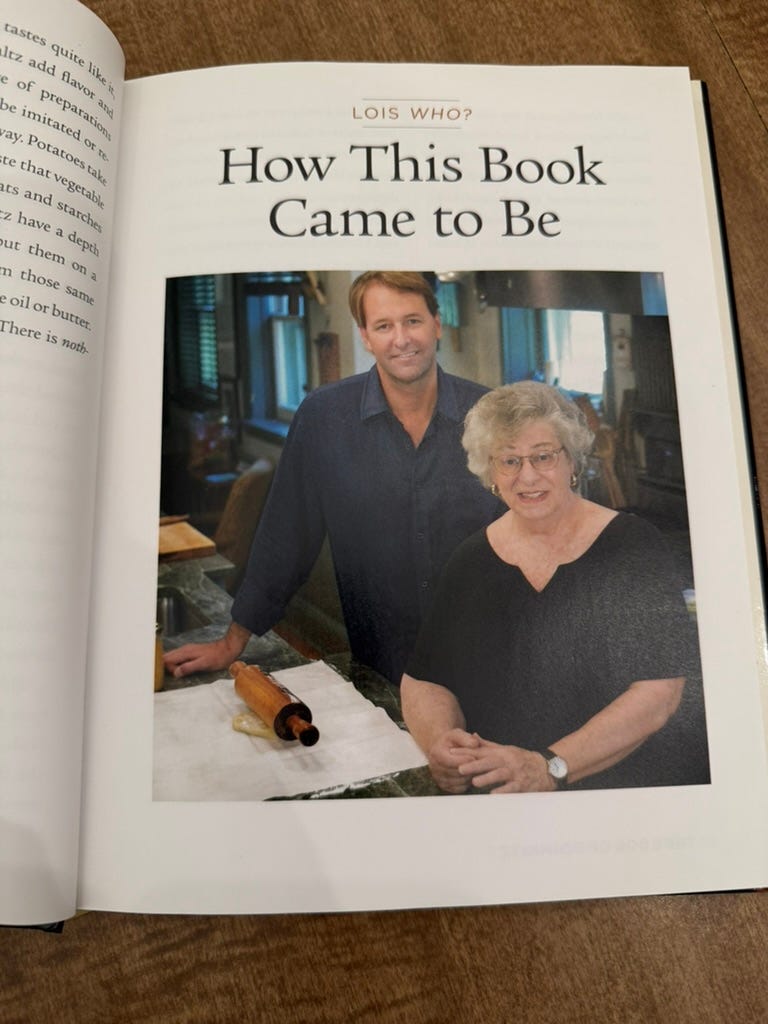
Whenever I cook, I think about Lois. She, along with my Grandma Joanne (Lois’ sister, who died two years ago) and perhaps Bobby Flay, was my primary culinary influence. For as long as I can remember she had coached me in the kitchen, dating back to our childhood sleepovers that always featured some kind of interactive baking project.
I called Lois every time I did something interesting in the kitchen. She was both my toughest critic and my greatest champion. She’d pick up the phone and immediately ask, “What are you cooking?” Her voice would light up if she was confident in my plans; she wasn’t shy about her reservations if she wasn’t. Sometimes she was right to warn against my harebrained ideas, like my attempt to make homemade farfel. But she loved hearing when they worked. The day she asked me for my latke recipe was one of the proudest moments of my life.
She got something out of the arrangement, too. It wasn’t just that my calls from the kitchen were a means of connecting with a woman who had always treated me like a surrogate grandson. Lois cared very deeply about keeping the family traditions alive. What else could have compelled her to devote so much time to reverse-engineering the specific combination of midcentury dairy products that gave her mother’s macaroni and cheese its signature texture? Or to mentor a celebrity chef in the art of Ashkenazi depression cuisine? When I’d call while wrist-deep in chicken fat, she would sound not just excited but grateful: “You’re the only one who still makes this!”
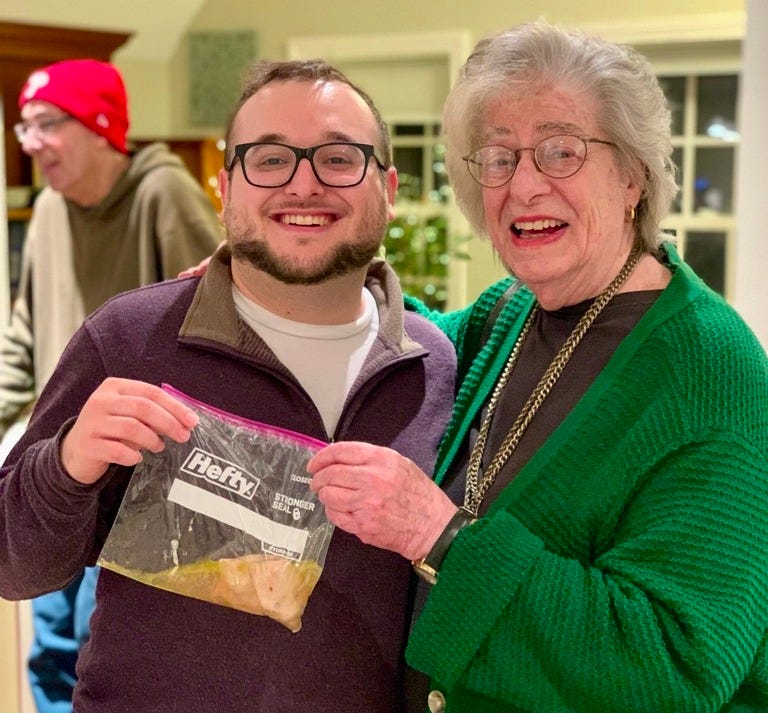
The last time I saw Lois was Thanksgiving. We mostly do holidays with my wife’s family and plan our Cleveland trips for other times of year. The combination of death, estrangement, and geographical scattering has simply left us with fewer people in Ohio to celebrate with than we have on the east coast. But last fall we came in to help put on Thanksgiving for the alte kakers. We made Lois’ famous pies — pumpkin with Grand Marnier and her incomparable chocolate cream — under her direction. I fulfilled a lifelong dream by replacing the traditional turkey with a brisket, and Lois finally got to try the recipe I’d been telling her about for years. We flipped through the family cookbook and reminisced about our favorite recipes, and all the people we loved who had cooked and eaten them.
To me, the most amazing thing about Barcelona’s Sinagoga Major was the story of its rediscovery. It was unearthed and identified just 30 years ago, within my lifetime. Among the crucial clues proving that it was the ancient site of local worship is an inscription carved into the stone foundation of a wall facing towards Jerusalem: XIIX. That’s 18 — or chai, a symbolic number in Judaism — written in Roman numerals. The language is archaic, but the significance is as clear to us today as it was to its ancient scribe almost two millennia prior.
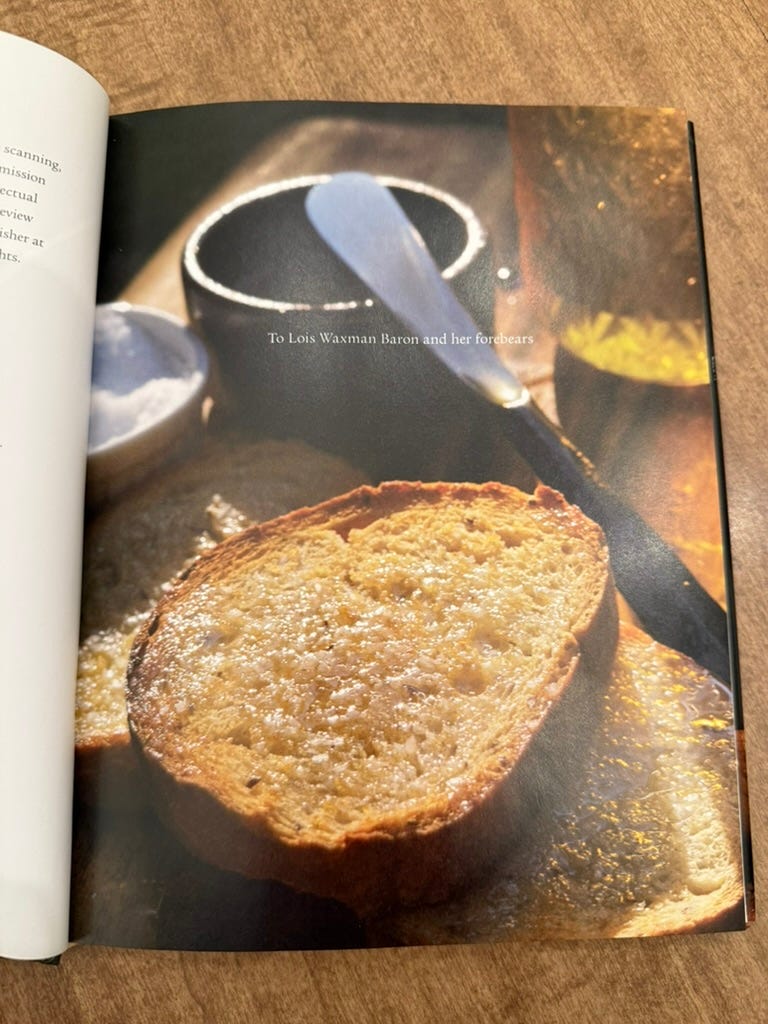
As I write this, there is proto-schmaltz simmering on the stove. I’ve lost track of how many times today I have sought guidance in the process from our treasured copy of The Book of Schmaltz, which contains some generation-spanning messages of its own. Michael was kind enough to dedicate the book to our family: “To Lois Waxman Baron and her forebears.”
The copy Lois bestowed upon my wife and me also has a special inscription, one that increasingly reads to me less like an encouragement than a decree:
To Lizzie + Lewie —
Who will lovingly carry on the family traditions.
Love,
Auntie Pool
And so I cook. I will proudly use homemade schmaltz in my matzoh ball soup, just as she would. I will chop the gribenes into my wicked eggs, just as she did with her egg salad. I think she would get a kick out of the rest of my planned menu, a tribute to some of her classic dishes with Seder-plate-themed twists. I bet she’d like my idea of lamb-on patties, a play on her popular salmon cakes. She wouldn’t pretend to be confident in my vision of matzoh-roni and cheese, but she would be excited either to hear that it worked or to get to say she told me so. That was part of our tradition too.
What makes the Passover holiday so special? It’s the connection of the ritual, with generations long past and the loved ones we remember. It sounds trite to describe the feeling in such a way. Leave it to Lois to inspire such schmaltz.
Oh Lewie, she would have loved, loved, loved this tribute. As I'm sure you've heard we gathered with almost no homemade foods (except your mom's delicious haroset), but she was with us in spirit for sure. It was our first gathering around the dining room table since she left us and dad got sick, and it was soooooo good to be able to do it. Much love to you and Lizzie!
This is so heartwarming ❤️!